

YOUR VOICE IS ALREADY THERE
My friends can easily spot me around town.
It's not because I'm famous. It's because they see pink — and they think Jackie.
From 2010 to 2012, I drove a pink Expedition around town — back when I was a mom of 5 boys ages 2 to 12, hauling kids and gear and snacks and equipment everywhere. Pink SUV, five wild boys. Yeah, I committed.
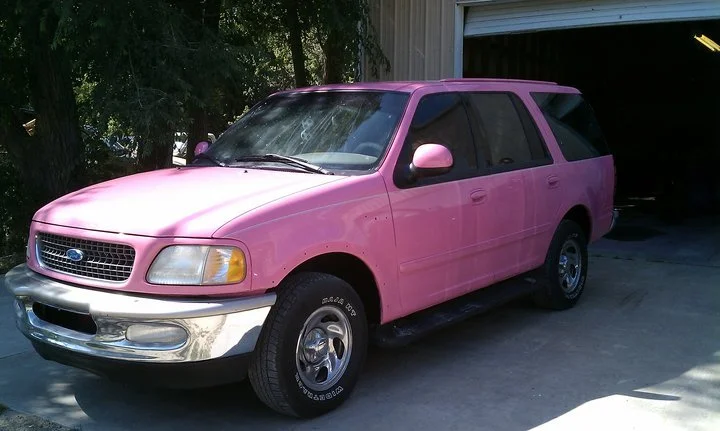
Personal photo, August 2010.
For the last 8 years, I've driven a white car with a pink steering wheel cover and a bright pink front license plate. I wear pink tops more often than not. And anywhere I show up — meetings, events, the grocery store — I'll get a text, a wave, or a "that is SO Jackie" moment.
That's not an accident. That's brand identity working in real life.
And what most small business owners miss is this — your brand voice works exactly the same way. It's not just what you say. It's what people recognize about you the moment they see, hear, or read anything from you.
The question isn't "do I have a voice?" You already do.
The question is — are you actually using it?
Voice Isn't Just Words
Most business owners think brand voice means "the words I use in captions." It's bigger than that.
Your voice is the personality behind every email, every Facebook post, every voicemail, every conversation at the front counter. It's the way someone "hears" you the moment they read anything from you. It's the difference between a business that sounds like it could be anywhere — and a business that sounds like yours.
And here's the thing — there's a difference between voice and tone, and most people use them interchangeably.
Voice is who you are. It stays the same. Tone is how you say it. It changes with the situation.
The way I talk at a community event is different from the way I'd talk at a funeral. Different tone — but I'm still the same person. Still recognizable. Still me.
Your business works the same way. Voice stays consistent. Tone adapts to the moment.
Why So Many Businesses Sound Like Nobody
I see this all the time. Small business owners sit down to write something — a website, a Facebook post, an About page — and freeze. They suddenly forget how to talk. They put on this weird, formal voice they'd never actually use in real life.
Underneath all of that? It's almost always the same thing.
Imposter syndrome.
Who am I to sound this confident? Who am I to be sassy? Who am I to have opinions? What if I write the way I talk and it doesn't sound smart enough? Professional enough? Serious enough?
So they write like a robot. Or like a brochure. Or like every other business in their industry. Because at least that feels safe.
The problem is — safe is also forgettable.
I Had to Give Myself Permission Too
When I started Market Me Pink, I tried to sound like a marketing expert. Polished. Professional. The kind of writing that could've come from any agency website in the country.
It was fine. It was also completely forgettable. And it didn't sound like me.
The shift came from giving myself permission to write the way I actually talk. To say "real talk" because that's what I actually say. To use phrases like "that's the PINK way" because they feel like me. To be a little sassy. To be confident without apologizing for it.
The same way I gave myself permission to drive a pink Expedition in 2010 when literally no one else was doing that — surrounded by five boys, in the middle of the busiest season of my life.
Once I leaned in, the right people started recognizing me.
When Your Voice Sticks, It Becomes Language
Here's what surprised me. The more I leaned into my actual voice, the more certain phrases just started sticking.
"Pinkified." When I help a business with their branding, marketing, or content, I'm not just consulting — I'm pinkifying them.
"Jackified." When I take something a client is struggling with and rework it into something that actually sounds like them and works for their business, that's getting Jackified.
"That's the PINK way." This one wraps up every blog post, every Facebook caption, every email — clear, consistent, confident.
None of those were brainstormed in a strategy session. They came out of me — because I was finally writing the way I talked. The branded phrases came AFTER the permission. Not before.
Now they're recognizable. They're mine. And they show up everywhere my brand does.
Write the Way You Talk
If I could give one piece of advice on this, that's it.
Write the way you talk.
Not the way a marketing book tells you to write. Not the way your competitors write. Not the polished, professional, "this could be on any business website" version. The way YOU talk.
If you say "y'all" in real life, write "y'all." If you trail off with "...anyway" because that's how you talk, do that. If you laugh at your own jokes, let your writing be funny.
Read what you write out loud. If it sounds weird coming out of your mouth — it IS weird. Rewrite it.
Your voice doesn't need to be polished. It needs to be RECOGNIZABLE.
Consistency Is Where the Magic Happens
Here's where it all comes together — your voice only works if you use it consistently.
One on-brand Facebook post doesn't build a voice. Three years of on-brand Facebook posts does.
One pink steering wheel cover doesn't make my friends see pink and think Jackie. Fifteen years of always showing up in pink does.
And the data backs it up — companies with consistent branding across touchpoints experience up to a 23% lift in revenue, with top performers reporting as much as 33% growth. Consistency also boosts brand recognition by up to 80%. Shapo
Voice + consistency = recognition. Recognition = trust. Trust = business.
Every email, every caption, every voicemail, every conversation — all of it is either building your voice or watering it down.
Permission Slip
If you've been holding back — sounding more "professional" than you actually are, watering yourself down, copying the voice of bigger brands because you don't think yours is enough — let this be your permission slip.
You don't need to sound like a marketing expert. You don't need to sound like anyone else. You're not going to scare away the right customers by sounding like yourself.
Actually — the opposite. Sounding like yourself is what makes the right customers feel like they already know you.
The most powerful thing your business can sound like is you. Confidently. Consistently. Unapologetically.
Need Help?
If you've been struggling to find your voice — or you have one and you don't know how to use it consistently across your website, social media, and marketing — this is one of my favorite things to help business owners with.
Sometimes you just need someone to read what you've written and tell you "yes, this sounds like you" — or "no, this sounds like you trying to be someone else."
Either way, let's get your brand sounding like you — Pinkified, Jackified, and all.
